Profile of an AI-Ready Graduate

AI Skills That Matter

Today's students will enter a workforce shaped by AI. Educators have a responsibility to prepare them for it.

But preparation means more than AI literacy. Students need to know how to partner with AI to become better thinkers, creators, and problem solvers. The Profile of an AI-Ready Graduate defines the higher-order skills that emerge when students and AI work together.

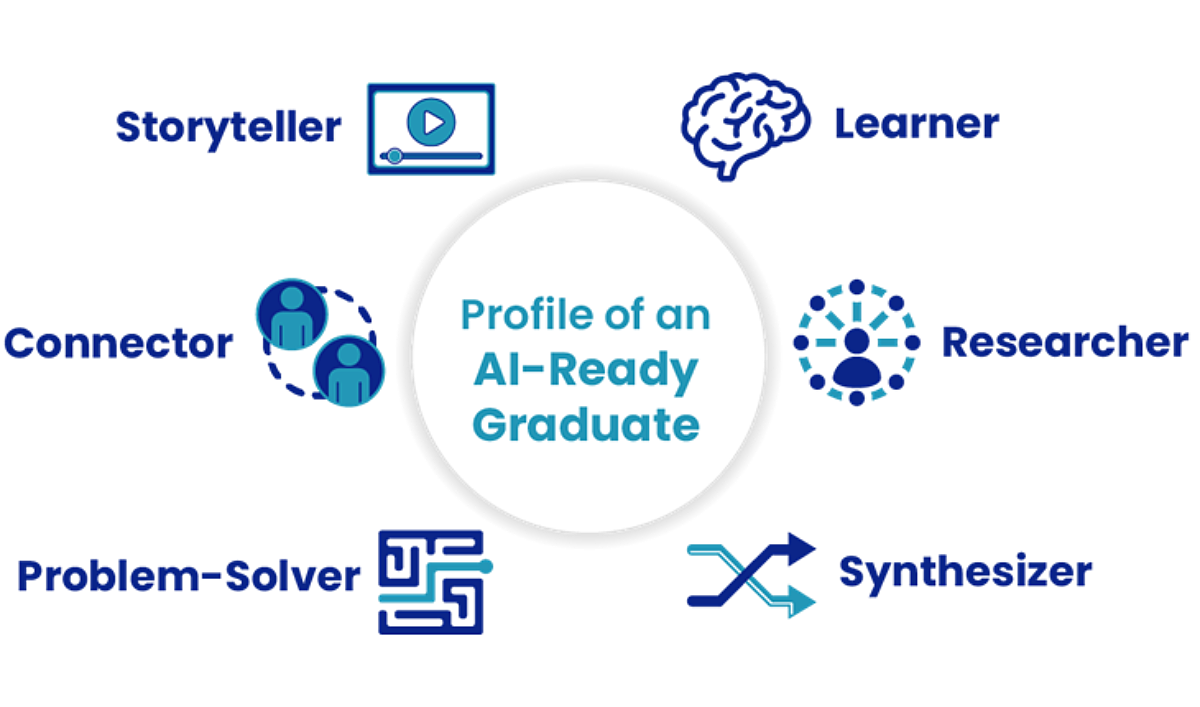
The following content is organized in 6 tabs: Learner, Researcher, Synthesizer, Problem Solver, Connector, Storyteller.

Learner

A blue and white graphic of a simplistic brain.

Students know how to use artificial intelligence (AI) to set learning goals, create plans for learning new skills, identify strategies to get unstuck, and seek targeted feedback to improve performance and understanding.

AI-ready graduates know how to use artificial intelligence to help them identify skills needed to meet their future learning and career goals, and plan pathways for learning those skills that match their unique needs and interests. Learners know how to use AI to get “unstuck” when learning a new skill becomes overwhelming or leads to a dead end. They also know how to seek performance feedback from AI that is immediate, specific, and actionable (e.g., suggestions for improving writing, identifying weaknesses in reasoning, correcting pronunciation in language learning, etc.).
 

Skills & Practices
 

  1. Self-Directed Goal Setting and Planning
    1. Students use AI to focus loosely defined goals into more actionable ones.
    2. Students use AI to identify learning pathways aligned to knowledge or skills that match their needs and interests.
       
  2. Getting Unstuck
    1. Students use AI to help identify specific areas of confusion (e.g., using AI to ask a series of diagnostic questions, analyze a photo of their work to help identify areas of struggle, etc.).
    2. Students use AI to get targeted help to increase their understanding or improve performance (e.g., request simpler explanations, different approaches, possible next steps, etc.)
       
  3. Seeking Feedback
    1. Students use AI to seek feedback on the structure of their work that may need improvement (e.g., organization, strength of evidence, effectiveness of design).
    2. Students use AI feedback to iteratively revise and improve their work until they are satisfied with the outcome.
Researcher

A blue and teal icon of a person at the center of a wheel shape made of dashes and dots.

Students know how to use AI to strategically investigate and analyze topics, evaluate claims, and compare sources of information.

AI-ready graduates know how to use artificial intelligence as a research assistant that helps them think more comprehensively and critically about complex topics. Researchers use AI to investigate topics systematically, draw from diverse sources, and recognize various points of conflict and areas of agreement.


Skills & Practices
 

  1. Planning the Inquiry
    1. Students use AI to identify topics of interest and shape them into questions worth exploring.
    2. Students use AI to explore a variety of approaches for starting their research (e.g., reviewing basic concepts, tracing historical development, grounding it in real examples).
       
  2. Evaluating Sources and Claims
    1. Students use AI to locate a variety of sources on a complex topic (e.g., research studies, expert opinions, news, policies) and identify viewpoints that might be underrepresented.
    2. Students use AI to identify key arguments from a variety of sources and investigate where experts agree or differ.

Synthesizer

Two simple arrow shapes in blue and teal starting in top and bottom corners on the left, crossing over each other midline and ending up in opposite corners on the right.

Students know how to use AI to synthesize, remix, and refine information into formats and levels of complexity that best meet their unique needs and capabilities.

AI-ready graduates know how to use artificial intelligence to bring information together from various sources to increase understanding and illuminate connections. Synthesizers also know how to use AI to relevel information to match their understanding, and determine when it is appropriate to stretch themselves to match the level of the material. They use AI to adapt information for different contexts. This includes changing media formats (audio to text, text to video, etc.) to get information in a format that is most appropriate for a given context.
 

Skills & Practices
 

  1. Remixing to Gain Deeper Thoughts
    1. Students use AI to convert content between different media formats to best match their learning needs.
    2. Students use AI to adjust the complexity of content to best align to their level of understanding.
       
  2. Finding Patterns
    1. Students use AI to gather and illuminate patterns across a wide range of data types and formats.
    2. Students test patterns they have discovered to see if they hold true across different contexts.

Problem Solver

A blue graphic of a simple maze with a teal colored line running through it from start to finish.

Students know how to use AI as a brainstorming partner to clarify challenges, generate new ideas, explore a wide range of possibilities, and evaluate potential solutions.

AI-ready graduates know how to use artificial intelligence to spur their own thinking, break through creative blocks, and explore alternative perspectives they may not have otherwise encountered on their own. Problem-Solvers engage in generative conversations that help them define problems and identify potential solutions and processes to solve problems. Throughout, they maintain critical judgment about which AI-generated insights to accept, adapt, or reject. 
 

Skills & Practices
 

  1. Refining Problems
    1. Students use AI to frame a problem worth solving and define it clearly to guide the search for solutions.
    2. Students use AI to analyze evidence (e.g., data, interviews, prior attempts) to better understand the problem’s complexity, causes, and constraints.
       
  2. Generating and Evaluating Ideas
    1. Students use AI as a brainstorming partner to expand their thinking and push them to identify more potential options before selecting a path forward.
    2. Students use AI to probe their most promising approaches for weaknesses, risks, and implementation challenges.
    3. Students use AI to identify human and simulated experts, as appropriate, to provide feedback on potential solutions.

Connector

A blue and teal icon of two separate circles each containing the figure of a person connected by black dotted lines.

Students know how to use AI to increase human collaboration, including overcoming language barriers and finding common ground among divergent perspectives.

AI-ready graduates know how to use artificial intelligence to facilitate deeper human connections. This includes using it to break down barriers between people who speak different languages and come from different backgrounds. Connectors use AI to elicit diverse perspectives, including, for example, from historical figures or digital personas. They also strengthen teams by identifying shared values, recommending additional team members, and making teams more effective and accountable. 
 

Skills & Practices
 

  1. Expanding Perspectives and Networks
    1. Students use AI to communicate and collaborate with people who speak different languages, including using language translation to preserve cultural nuances and emotional tone.
    2. Students use AI to simulate divergent cultural, geographic, and intellectual viewpoints that may otherwise be out of reach (e.g., historical figures, experts, critics) as a starting point for increasing empathetic understanding.
    3. Students use AI to suggest potential mentors, volunteer opportunities, or apprenticeships that align with their needs, interests, and aspirations.
       
  2. Improving Team Collaboration
    1. Students use AI to suggest people who would strengthen a team based on their role (e.g., mentor, teammate, collaborator) shared interests, complementary skills, and unique perspectives.
    2. Students use AI to suggest streamlined team structures and processes, and coordinate tasks and track responsibilities.
    3. Students use AI to practice navigating difficult, complex or high-stakes conversations to prepare for more productive human interactions.

Storyteller

A blue and teal graphic representing a video player with a progress bar and a large play button inside the screen.

Students know how to use AI to craft compelling narratives and communicate complex ideas through text, image, audio, video, and other media.

AI-ready graduates use artificial intelligence to enhance their ability to tell compelling stories and connect with others, sharpening their narratives, improving their presentations, and finding new ways to visualize complex concepts in formats beyond text. Storytellers might collaborate with AI to create visual metaphors for abstract ideas or use it to generate media to convey information in ways that resonate more powerfully with their intended audiences. 
 

Skills & Practices
 

  1. Sharpening the Message
    1. Students use AI to refine their messaging, anticipate potential misunderstandings and objections, and establish a call to action that fits their target audience.
    2. Students use AI to identify language, tone, and examples (e.g., case studies, anecdotes, metaphors) to create a compelling message.
    3. Students use AI to identify outreach strategies and suitable channels to effectively reach their target audience.
       
  2. Creating Visual and Audio Content
    1. Students use AI to visualize abstract concepts through diagrams, analogies, interactive media, and other explanatory formats.
    2. Students use AI to generate suggestions for tone and media format (slideshow, video, infographic, podcast) for their intended audience and message.
    3. Students use AI to produce and refine media content (images, audio, video, etc.) that compellingly communicates their message.

The Profile of an AI-Ready Graduate was developed with support from Britebound, a national nonprofit dedicated to helping middle and high school students discover their strengths and navigate their path to postsecondary and career success. Learn more at britebound.org.

Download the Profile of an AI-Ready Graduate

Begin your AI Journey.

Download PDF Now

Built on Proven Foundations

The profile's AI skills rest on a foundational framework. The ISTE Standards for Students build digital literacy and guide ethical, creative use of technology. Together, these frameworks share core values of human connection, lifelong learning, and student agency.

Learn and Engage with AI

Google AI Educator Series

This series is designed for leaders and educators in schools or universities to learn AI fundamental concepts, thinking critically about using AI to improve teaching and learning.

AI in Action

Learn more from educators through examples of how they are implementing AI with purpose to support learning.

Adopt the Profile of an AI-Ready Graduate

Use the profile to guide your school in meaningful use of AI for learning. Reach out for support to align your existing initiatives to the profile.