
Journal of Digital Learning in Teacher Education
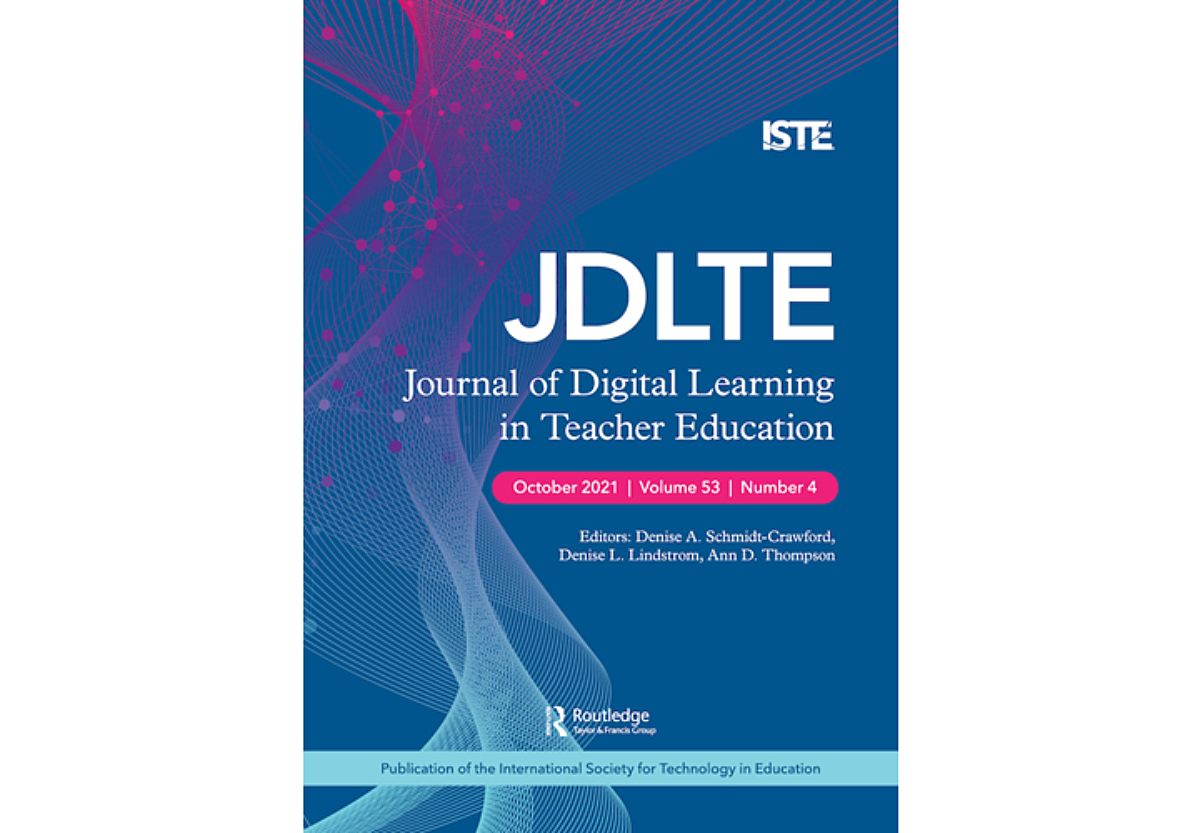
The Journal of Digital Learning in Teacher Education (JDLTE) publishes research centered on computer and technology education for preservice and inservice teachers.
ISTE+ASCD Pro Members enjoy full access to JDLTE as well as JRTE. Log in to the member portal and the journals are available via a menu at the top of the following page.
Read abstracts and open access articles from the latest issue on the partner site hosted by Taylor & Francis.

Subscription Information
ISTE+ASCD Pro Members receive four digital issues of JDLTE per year with their membership.
- Nonsubscribers may read the latest issue and browse tiles and abstracts.
- Join ISTE+ASCD today or subscribe to JDLTE through our third-party provider, Taylor & Francis Group.
About this Journal
The ISTE Journal of Digital Learning in Teacher Education (JDLTE) (formerly the Journal of Computing in Teacher Education) is a refereed journal that provides access to the growing body of research addressing the use of digital technologies in teacher education. Articles highlight contemporary trends and effective, creative and innovative uses of digital technologies that prepare preservice, inservice and teacher educators for teaching in technology-rich learning environments.
Editors
Ann Thompson, Ph.D., Iowa State University
Denise Schmidt-Crawford, Ph.D., Iowa State University
Denise Lindstrom, Ph.D., Fairmont State University
jdigitalteacher@gmail.com
JDLTE Submission Guidelines
JDLTE welcomes submissions that are of interest to teacher educators who are involved with computer and technology education for preservice and inservice teachers.
Content
Submissions should be of interest to teacher educators who are involved with computer and technology education for preservice and inservice teachers. Submissions should also make a major contribution to the field in one or more of the following areas:
Practical. What could a teacher educator use right now with preservice or inservice courses or programs? What kind of computer and technology training is being done? Why? How has it worked? What funding issues have arisen? What is happening in K-12 computer education that relates to teacher education programs?
Theoretical. What thoughts, insights or principles can be presented as a theoretical basis for practical applications in teacher education programs with regard to computers and technology in education?
Leadership. What are the directions in teacher education as related to computer and technology education? How can educators become effective critics and implementers of innovations using technology?
Research. What research can be reported or synthesized that has bearing on computer and technology education programs in teacher education? What research can be reported concerning approaches to preservice and inservice computer and technology education? What research can be reported about uses of computers and technology in the schools that will affect the training of computer-using teachers?
In addition to the above, submissions should:
Fit the scope of JDLTE
Make a major practical, theoretical, leadership or research contribution to the field
Provide readers with a perspective of what is already in the literature
Be relevant to a wide range of readers
Format
Please make sure your article is adequately prepared for blind review. Please include the authors' names and contact information only on the first page of the manuscript. Include a 120-word abstract of the manuscript that conveys the main message to the reader. Include all references in a clearly marked reference section at the end.
Save your manuscript file as a Word doc. Double-space all copy and set margins at least 1" on all sides. Include appropriate visuals, charts, diagrams, drawings and tables. You may insert graphics into your manuscript file to indicate placement, but you must also provide the original graphics files. Please don't take a screenshot and copy it into your file; copy it instead into a graphics editor and save it as a TIFF, BMP or PIC. Number all pages.
Style
Follow standard APA style (7th ed.). Proofread carefully, as editing does not routinely include major rewriting or stylistic correction. Authors are responsible for the correctness and consistency of their words. Double-check and update all references. Avoid sexist or similarly biased language. Use wording that minimizes awkwardness, bias and ambiguity.
Length
Articles should be approximately 4,000-6,000 words, which includes the 120-word abstract but not references and figures.
Review
Do not submit material that is currently being considered by another journal. Research articles will be assessed on these additional criteria, where appropriate:
- Importance of the topic
- Definition of the research problem
- Appropriateness of the design and approach
- Clarity of hypotheses or research questions
- Appropriateness and definition of the population
- Reliability of critical measures
- Appropriateness of descriptive statistics and data analyses
- Clarity and accurateness of data tables
- Relationship of data presented to conclusions drawn
- Acknowledgment of alternative interpretations of the data
- Support of recommendations by the research findings
- Clarity of applications of findings to practice
Submission
JDLTE now processes all manuscript submissions electronically via its ScholarOne Manuscripts website. ScholarOne allows rapid submission of original and revised manuscripts and facilitates the review process and internal communication between authors, editors and reviewers via a web-based platform.
If you have difficulty submitting your article, please contact ScholarOne’s technical support team. For questions about JDLTE, please contact the journal’s editors, Ann Thompson and Denise A. Schmidt-Crawford, at jdigitalteacher@gmail.com.
Acceptance and Publication
If the editors choose to accept the article for publication, they will notify the corresponding author. Authors will receive copies of the issue of the journal containing their article.